 Q. No.
Carnivorous animals - lions and leopards, occupy the same niche but lions predate mostly larger animals and leopards take smaller ones. This mechanism of competition is referred to as:
| 1. | Character displacement | 2. | Altruism |
| 3. | Resource partitioning | 4. | Competitive exclusion |


Match the items in Column-I with those in Column-II:
| Column-I | Column-II | ||
| (a) | Herbivores-Plants | (i) | Commensalism |
| (b) | Mycorrhiza-Plants | (ii) | Mutualism |
| (c) | Sheep-Cattle | (iii) | Predation |
| (d) | Orchid-Tree | (iv) | Competition |
Select the correct option from the following:
| Options: | (a) | (b) | (c) | (d) |
| 1. | (iv) | (ii) | (i) | (iii) |
| 2. | (iii) | (ii) | (iv) | (i) |
| 3. | (ii) | (i) | (iii) | (iv) |
| 4. | (i) | (iii) | (iv) | (ii) |
| List-I (Interacting species) | List-II (Name of Interaction) | ||
| A. | A Leopard and a Lion in a Forest/grassland | I. | Competition |
| B. | A Cuckoo laying an egg in a Crow's nest | II. | Brood parasitism |
| C. | Fungi and root of a higher plant mycorrhizae | III. | Mutualism |
| D. | A cattle egret and a Cattle in a field | IV. | Commensalism |
Choose the correct answer from the options given below:
| Options: | A | B | C | D |
| 1. | II | III | I | IV |
| 2. | I | II | III | IV |
| 3. | I | II | IV | III |
| 4. | III | IV | I | II |


In which of the following interactions both partners are adversely affected?
| 1. | Competition | 2. | Predation |
| 3. | Parasitism | 4. | Mutualism |
1. feeding at the same time.
2. choosing different foraging patterns.
3. increasing time spent on attacking each other.
4. predating on each other.
According to Darwin, organic evolution is due to:
| 1. | Interspecific competition. |
| 2. | Competition within closely related species. |
| 3. | Reduced feeding efficiency in one species due to the presence of interfering species. |
| 4. | Intraspecific competition. |


1. primary succession
2. limiting resources
3. Müllerian mimicry
4. competitive exclusion
| Assertion (A): | Connell's elegant field experiment showed that on the rocky sea, the larger and competitively superior barnacles dominate the intertidal area and exclude the smaller barnacles from that area. |
| Reason (R): | Generally, herbivores and plants appear to be more adversely affected by competition than carnivores. |
| 1. | Both (A) and (R) are True and (R) is the correct explanation of (A) |
| 2. | Both (A) and (R) are True but (R) is not the correct explanation of (A) |
| 3. | (A) is True but (R) is False. |
| 4. | (A) is False but (R) is True. |
Sorry!! currently, the explanation for the question is not provided. If you need further help, please email at support@neetprep.com with subject: Explanation Missing for Question Id: 456895
Sorry!! currently, the explanation for the question is not provided. If you need further help, please email at support@neetprep.com with subject: Explanation Missing for Question Id: 456895
The following graph depicts changes in two populations (A and B) of herbivores in a grassy field. A possible reason for these changes is that:
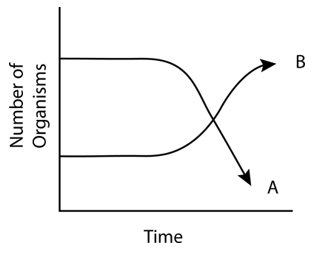
| 1. | both plant populations in this habitat decreased |
| 2. | population-B competed more successfully for food than population-A |
| 3. | population-A produced more offspring than population-B |
| 4. | population-A consumed the members of population-B |


| 1. | lack of a keystone species |
| 2. | low species richness |
| 3. | pronounced intraspecific competition |
| 4. | resource partitioning |

© 2026 GoodEd Technologies Pvt. Ltd.