
 Q. No.
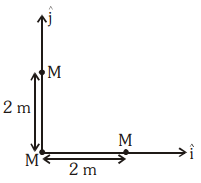
Three identical spheres, each of mass \(M\), are placed at the corners of a right-angle triangle with mutually perpendicular sides equal to \(2~\text{m}\) (see figure). Taking the point of intersection of the two mutually perpendicular sides as the origin, find the position vector of the centre of mass.
1.
\(2( \hat{i}+ \hat{j})\)
2.
\(( \hat{i}+ \hat{j})\)
3.
\({2 \over 3}( \hat{i}+ \hat{j})\)
4.
\({4 \over 3}( \hat{i}+ \hat{j})\)


A uniform square plate \(ABCD\) has a mass of \(10\) kg.
If two point masses of \(5\) kg each are placed at the corners \(C\) and \(D\) as shown in the adjoining figure, then the centre of mass shifts to the mid-point of:

1. \(OH\)
2. \(DH\)
3. \(OG\)
4. \(OF\)
At \(t=0,\) the positions of the two blocks are shown. There is no external force acting on the system. Find the coordinates of the centre of mass of the system (in SI units) at \(t=3\) seconds.

| 1. | \((1,0)\) | 2. | \((3,0)\) |
| 3. | \((4.5,0)\) | 4. | \((2.25,0)\) |


The mass per unit length of a non-uniform rod of length \(L\) is given by \(\mu =λx^{2}\) where \(\lambda\) is a constant and \(x\) is the distance from one end of the rod. The distance between the centre of mass of the rod and this end is:
| 1. | \(\frac{L}{2}\) | 2. | \(\frac{L}{4}\) |
| 3. | \(\frac{3L}{4}\) | 4. | \(\frac{L}{3}\) |

A rod is falling down with constant velocity \(V_0\) as shown. It makes contact with hinge A and rotates around it. The angular velocity of the rod just after the moment when it comes in contact with hinge A is:

| 1. | \(2 \mathrm{V}_0 / 3 \mathrm{L} \) | 2. | \(3 \mathrm{V}_0 / 2 \mathrm{L} \) |
| 3. | \(\mathrm{V}_0 / \mathrm{L} \) | 4. | \(2 \mathrm{V}_0 / 5 \mathrm{L}\) |
The law of conservation of angular momentum is valid when:
| 1. | The net force is zero and the net torque is non-zero | 2. | The net force is non-zero and the net torque is non zero |
| 3. | Net force may or may not be zero and net torque is zero | 4. | Both force and torque must be zero |


The angular speed of the wheel of a vehicle is increased from \(360~\text{rpm}\) to \(1200~\text{rpm}\) in \(14\) seconds. Its angular acceleration will be:
1. \(2\pi ~\text{rad/s}^2\)
2. \(28\pi ~\text{rad/s}^2\)
3. \(120\pi ~\text{rad/s}^2\)
4. \(1 ~\text{rad/s}^2\)
Particles \(A\) and \(B\) are separated by \(10~\text m,\) as shown in the figure. If \(A\) is at rest and \(B\) started moving with a speed of \(20~\text{m/s}\) then the angular velocity of \(B\) with respect to \(A\) at that instant is:

| 1. | \(1~\text{rad/s}\) | 2. | \(1.5~\text{rad/s}\) |
| 3. | \(2~\text{rad/s}\) | 4. | \(2.5~\text{rad/s}\) |
The value of \(M\), as shown, for which the rod will be in equilibrium is:

| 1. | \(1\) kg | 2. | \(2\) kg |
| 3. | \(4\) kg | 4. | \(6\) kg |


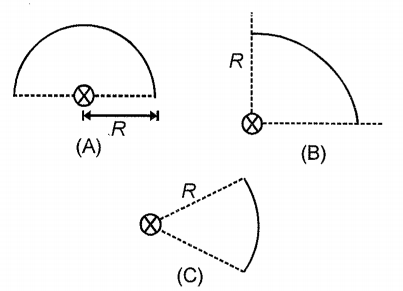
In the three figures, each wire has a mass M, radius R and a uniform mass distribution. If they form part of a circle of radius R, then about an axis perpendicular to the plane and passing through the centre (shown by crosses), their moment of inertia is in the order:
1.
2.
3.
4.

© 2026 GoodEd Technologies Pvt. Ltd.