- 1(current)
 Q. No.
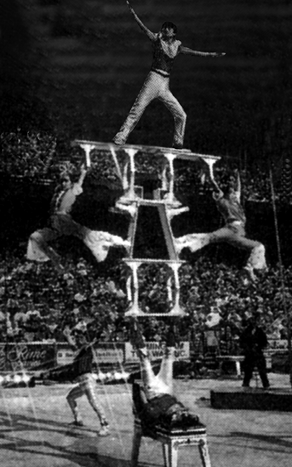
In a human pyramid in a circus, the entire weight of the balanced group is supported by the legs of a performer who is lying on his back (as shown in the figure below). The combined mass of all the persons performing the act, and the tables, plaques, etc. involved is \(280~\text{kg}\). The mass of the performer lying on his back at the bottom of the pyramid is \(60~\text{kg}\). Each thighbone (femur) of this performer has a length of \(50~\text{cm}\) and an effective radius of \(2.0~\text{cm}\). The amount by which each thighbone gets compressed under the extra load is: (The Young’s modulus for bone is given by, \(Y = 9.4\times 10^9~\text{N/m}^{2}\))
1. \(4.55\times 10^{-5}~\text{cm}\)
2. \(5.45\times 10^{-3}~\text{cm}\)
3. \(5.45\times 10^{-5}~\text{cm}\)
4. \(4.55\times 10^{-3}~\text{cm}\)


- 1(current)
Q. No.
© 2026 GoodEd Technologies Pvt. Ltd.