
 Q. No.
A rope of negligible mass is wound around a hollow cylinder of mass \(3\) kg and radius \(40\) cm. What is the angular acceleration of the cylinder if the rope is pulled with a force of \(30\) N?
(Assume that there is no slipping.)
1. \(21\) rad/s2
2. \(24\) rad/s2
3. \(20\) rad/s2
4. \(25\) rad/s2


To maintain a rotor at a uniform angular speed of \(200~\text{rad/s},\) an engine needs to transmit a torque of \(180~\text{N-m}.\) What is the power required by the engine?
1. \(33~\text{kW}\)
2. \(36~\text{kW}\)
3. \(28~\text{kW}\)
4. \(76~\text{kW}\)


A meter stick is balanced on a knife edge at its center. When two coins, each of the mass \(5\) gm are put one on top of the other at the \(12.0\) cm mark, the stick is found to be balanced at \(45.0\) cm. What is the mass of the meter stick?
1. \(66~\text{gm}\)
2. \(56~\text{gm}\)
3. \(76~\text{gm}\)
4. \(79~\text{gm}\)
Three identical spheres, each of mass \(M\), are placed at the corners of a right-angle triangle with mutually perpendicular sides equal to \(2~\text{m}\) (see figure). Taking the point of intersection of the two mutually perpendicular sides as the origin, find the position vector of the centre of mass.
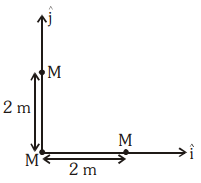
| 1. | \(2( \hat{i}+ \hat{j})\) | 2. | \(( \hat{i}+ \hat{j})\) |
| 3. | \({2 \over 3}( \hat{i}+ \hat{j})\) | 4. | \({4 \over 3}( \hat{i}+ \hat{j})\) |
The coordinates of the centre of mass of a uniform plate of shape as shown in the figure are:

| 1. | \(\frac{L}{2}, \frac{L}{2} \) | 2. | \(\frac{5 L}{12}, \frac{5 L}{12} \) |
| 3. | \(\frac{5L}{3}, \frac{2L}{3}\) | 4. | \(\frac{3 L}{4}, \frac{L}{2}\) |


A rigid body rotates with an angular momentum of \(L.\) If its kinetic energy is halved, the angular momentum becomes:
1. \(L\)
2. \(L/2\)
3. \(2L\)
4. \(L/\)
A particle is moving with a constant velocity along a line parallel to the positive x-axis. The magnitude of its angular momentum with respect to the origin is:
| 1. | zero |
| 2. | increasing with \(x\) |
| 3. | decreasing with \(x\) |
| 4. | remaining constant |
The center of mass of a system of particles does not depend upon:
| 1. | position of particles |
| 2. | relative distance between particles |
| 3. | masses of particles |
| 4. | force acting on the particle |


A uniform square plate \(ABCD\) has a mass of \(10\) kg.
If two point masses of \(5\) kg each are placed at the corners \(C\) and \(D\) as shown in the adjoining figure, then the centre of mass shifts to the mid-point of:

1. \(OH\)
2. \(DH\)
3. \(OG\)
4. \(OF\)

© 2026 GoodEd Technologies Pvt. Ltd.