
 Q. No.
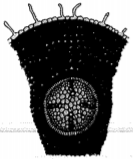
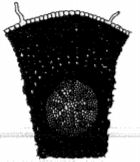
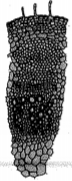
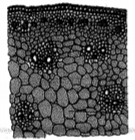
Which of the given figure represents the internal structural details of a monocot root?
1. 
2. 
3. 
4. 


The most abundant and common tissue in plants
| 1. | Has non-vacuolated cytoplasm |
| 2. | Is living and has cellulosic wall |
| 3. | Stores ergastic substances always |
| 4. | Cannot take part in photosynthesis |
Monocot stems do not have
| 1. | Protophloem |
| 2. | Phloem parenchyma |
| 3. | Companion cell in phloem |
| 4. | Sieve tube and metaphloem |


Choose the correct option with respect to sclereids
| 1. | Physiologically active |
| 2. | Pits are present |
| 3. | Derived from meristems directly |
| 4. | Little amount of protoplasm is present |
The isobilateral leaf is characterized by all the given characteristics, except
| 1. | Vascular bundles are always closed |
| 2. | Xylem is towards the adaxial surface of leaf |
| 3. | Mesophyll cells are not differentiated |
| 4. | Parenchymatous extensions of the bundle sheath |
Collenchyma is characterised by
| 1. | Absence of protoplast at maturity |
| 2. | Supporting young stem and leaf petiole |
| 3. | Lignocellulosic thickening on secondary walls |
| 4. | The common presence of intracellular spaces |
Epidermal hairs on stems known as trichomes
| 1. | May sometimes be secretory in function |
| 2. | Have vascular supply |
| 3. | May be soft or stiff but unbranched always |
| 4. | Are endogenous in origin like lateral roots |
Select the incorrect statement with respect to bast fibres
| a. | Generally absent in primary phloem |
| b. | Elongated, branched with blunt ends |
| c. | Parenchymatous in nature |
| d. | Becomes dead at maturity |
1. a & d
2. b & d
3. b & c
4. a & b
Sieve tube elements are long, tube-like structures, arranged longitudinally and associated with the companion cells. A mature sieve element
| 1. | Has a small vacuole |
| 2. | Lacks nucleus and cytoplasm |
| 3. | Possesses a large vacuole and small nucleus |
| 4. | Possesses a peripheral cytoplasm |
Match the column I with column II
| Column I | Column II | ||
| a. | Xylem parenchyma | (i) | Absent in most of the monocots |
| b. | Sclereids | (ii) | Lond cylindrical tube-like structure |
| c. | Phloem parenchyma | (iii) | Food and tannins |
| d. | Vessel | (iv) | Fruit walls of nuts |
1. a(i), b(ii), c(iii), d(iv)
2. a(ii), b(iv), c(iii), d(i)
3. a(iii), b(iv), c(i), d(ii)
4. a(iii), b(ii), c(i), d(iv)

© 2026 GoodEd Technologies Pvt. Ltd.