
 Q. No.
Ethyl chloride is converted into diethyl ether by -
1.
Wurtz reaction
2.
Grignard reaction
3.
Perkin's reaction
4.
Williamson's synthesis


The product that forms when sodium phenoxide is heated with ethyl iodide is-
1. Phenetole
2. Ethyl phenyl alcohol
3. Phenol
4. None of the above


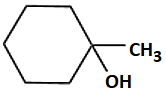




The major products C and D formed in the following reaction respectively are:
\(CH_3CH_2CH_2OC{(CH_3)}_3 \xrightarrow[\Delta]{\text{Excess}\ HI}\ C + D\)
1. H3C-CH2-CH2-I and I-C(CH3)3
2. H3C-CH2-CH2-OH and I-C(CH3)3
3. H3C-CH2-CH2-I and HO-C(CH3)3
4. H3C-CH2-CH2-OH and HO-C(CH3)3
Which of the following is produced when the vapours of secondary alcohol are passed over heated copper at 573 K?
| 1. | A carboxylic acid | 2. | An aldehyde |
| 3. | A ketone | 4. | An alkene |
Select the correct option based on statements below:
| Assertion (A): | The solubility of alcohols in water decreases with an increase in the number of carbon atoms. |
| Reason (R): | The non-polar alkyl group or the hydrophobic portion supports the solubility of alcohol. |
| 1. | Both (A) and (R) are True and (R) is the correct explanation of (A). |
| 2. | Both (A) and (R) are True but (R) is not the correct explanation of (A). |
| 3. | (A) is True but (R) is False. |
| 4. | Both (A) and (R) are False. |


Select the correct option based on statements below:
| Assertion (A): | Phenol does not react with NaHCO3 but 2,4,6-trinitrophenol does react with the evolution of CO2 |
| Reason (R): | 2,4,6-trinitrophenol is a stronger acid than carbolic acid. |
| 1. | Both (A) and (R) are True and (R) is the correct explanation of (A). |
| 2. | Both (A) and (R) are True but (R) is not the correct explanation of (A). |
| 3. | (A) is True but (R) is False. |
| 4. | (A) is False but (R) is True. |
Select the correct option based on statements below:
| Assertion (A): | Picric acid is more acidic than formic acid. |
| Reason (R): | Picric acid has three -COOH groups whereas formic acid has one -COOH group. |
| 1. | Both (A) and (R) are true and (R) is the correct explanation of (A). |
| 2. | Both (A) and (R) are true but (R) is not the correct explanation of (A). |
| 3. | (A) is true but (R) is false. |
| 4. | Both (A) and (R) are false. |
Select the correct option based on statements below:
| Assertion (A): | -OH, -OCH3 groups are o, p-directing. |
| Reason (R): | Ring is activated by the resonance effect of -OH, -OCH3 groups. |
| 1. | Both (A) and (R) are true and (R) is the correct explanation of (A). |
| 2. | Both (A) and (R) are true but (R) is not the correct explanation of (A). |
| 3. | (A) is true but (R) is false. |
| 4. | Both (A) and (R) are false. |


Ether is more volatile than alcohol despite having the same molecular formula. This is due to -
1. Dipolar character of ethers
2. Alcohols having resonance structures
3. Intermolecular hydrogen bonding in ethers
4. Intermolecular hydrogen bonding in alcohols

© 2026 GoodEd Technologies Pvt. Ltd.