
 Q. No.
Select the correct option based on statements below:
Assertion (A):
One part of micelles is lyophilic in nature.
Reason (R):
Micelles have a lyophillic COO group.
1.
Both (A) and (R) are true and (R) is the correct explanation of (A).
2.
Both (A) and (R) are true but (R) is not the correct explanation of (A).
3.
(A) is true but (R) is false.
4.
Both (A) and (R) are false.


Select the correct option based on statements below:
| Assertion (A): | A hydrophilic sol is more stable than a hydrophobic sol. |
| Reason (R): | When compared to hydrophobic sol, colloidal particles in hydrophilic sol are heavily hydrated. |
| 1. | Both (A) and (R) are true and (R) is the correct explanation of (A). |
| 2. | Both (A) and (R) are true but (R) is not the correct explanation of (A). |
| 3. | (A) is true but (R) is false. |
| 4. | Both (A) and (R) are false. |
Brownian motion of colloidal particles is caused by:
| 1. | Temperature fluctuations within the liquid phase. |
| 2. | Attraction and repulsion between charges on the colloidal particles. |
| 3. | Impact of the molecules of the dispersion medium on the colloidal particles. |
| 4. | None of the above. |


Measuring Zeta potential is useful in determining which of the following property of a colloidal solution:
1. Solubility.
2. Stability of the colloidal particles.
3. Size of the colloidal particles.
4. Viscosity.
How can alum help in water purification?
| 1. | Forming Si complex with clay particles. |
| 2. | The sulphate part, which combines with the dirt and removes it. |
| 3. | Aluminium which coagulates the mud particles. |
| 4. | Making mud water soluble. |
The coagulating power of electrolytes with ions Na+, Al3+, and Ba2+for arsenic sulphide sol increases in the order :
1.
2.
3.
4.




Which mixture of the solutions will lead to the formation of a negatively charged colloidal [AgI]I- sol?
1. 50 mL of 0.1 M AgNO3 + 50 mL of 0.1 M KI
2. 50 mL of 1 M AgNO3 + 50 mL of 0.5 M KI
3. 50 mL of 1 M AgNO3 + 50 mL of 2 M KI
4. 50 mL of 2 M AgNO3 + 50 mL of 1.5 M KI


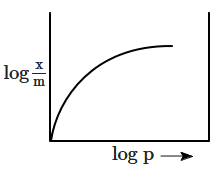
In the Freundlich adsorption isotherm, the value of 1/n is:
1. Between 0 and 1 in all cases.
2. Between 2 and 4 in all cases.
3. 1 in the case of physical adsorption.
4. 1 in the case of chemisorption.

© 2026 GoodEd Technologies Pvt. Ltd.