
 Q. No.
The incorrect formula among the following is:
1.
\(\text X_{\text{mole fraction}}=\frac{\text n_{\text{solute}}}{\text n_{\text{solution}}}\)
2.
\(\text{Molarity}=\frac{\text{amount of solute (g)}}{\text{volume of solution (mL)}}\)
3.
\(\text{Molality}=\frac{\text{Number of mole of solute}}{\text{amount of solvent (kg)}}\)
4.
\(\text{Mass percentage}=\frac{\text{mass of the component in the solution}}{\text{Total mass of the solution}}\times100 \)


The density of 68 % nitric acid by mass in an aqueous solution is 1.504 g mL–1. The molarity of the acid solution would be:
1. 15.24 M
2. 16.23 M
3. 14.52 M
4. 13.45 M
A solution of glucose (M.W. = 180 g mol–1) in water is 10 % w/w. The mole fraction of each component in the solution is:
| 1. | Mole fraction of glucose - 0.44; mole fraction of water - 0.56 |
| 2. | Mole fraction of glucose - 0.056; mole fraction of water - 0.944 |
| 3. | Mole fraction of glucose - 0.011; mole fraction of water - 0.99 |
| 4. | Mole fraction of glucose - 0.36; mole fraction of water - 0.64 |



A solution is obtained by mixing 300 g of 25 % solution and 400 g of 40 % solution by mass. The mass percentage of solute in the resulting solution is:
1. 33.5 %
2. 36.5 %
3. 37.4 %
4. 32.5 %
An antifreeze solution is prepared from 222.6 g of ethylene glycol (C2H6O2) and 200 g of water. The molality of the solution would be:
| 1. | 6.9 m | 2. | 17.9 m |
| 3. | 29.9 m | 4. | 21.9 m |
A drinking water sample was found to be contaminated with chloroform at a level of 15 ppm (by mass). What is the mass percent of chloroform in the sample?
1.
2.
3.
4.


The type of molecular interactions in a solution of alcohol and water is:
| 1. | Electrostatic interaction | 2. | London dispersion forces |
| 3. | Hydrogen bonding | 4. | Ion-dipole interaction |
The graph representing Henry's law is given below:

The value of the slope will be:
| 1. | \(4\times10^{-4}~\mathrm{torr}\) | 2. | \(5\times10^{-4}~\mathrm{torr}\) |
| 3. | \(4\times10^{4}~\mathrm{torr}\) | 4. | \(5\times10^{4}~\mathrm{torr}\) |
Points A and B in the below-mentioned graph represent, respectively:
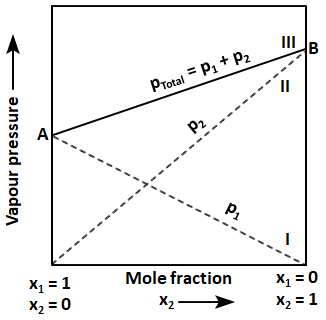
| 1. | Partial pressures of first and second components |
| 2. | Vapour pressures of the pure second and first components |
| 3. | Partial pressures of second and first components |
| 4. | Vapour pressures of the pure first and second components |


The law depicted by the provided graph is:

| 1. | Henry's law | 2. | Raoult's law |
| 3. | Boyle's law | 4. | Charle's law |

© 2026 GoodEd Technologies Pvt. Ltd.