
 Q. No.
For the given circuit of the \(\mathrm{p\text-n}\) junction diode, which of the following statements is correct?

1.
In F.B. the voltage across \(R\) is \(V.\)
2.
In R.B. the voltage across \(R\) is \(V.\)
3.
In F.B. the voltage across \(R\) is \(2V.\)
4.
In R.B. the voltage across \(R\) is \(2V.\)


Reverse bias applied to a junction diode:
| 1. | lowers the potential barrier |
| 2. | raises the potential barrier |
| 3. | increases the majority carrier current |
| 4. | increases the minority carrier's current |
The barrier potential of a \(\mathrm{p\text-n}\) junction diode does not depend on:
| 1. | diode design | 2. | temperature |
| 3. | forward bias | 4. | doping density |


Following diagram performs the logic function of:
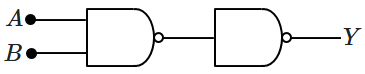
1. AND gate
2. NAND gate
3. OR gate
4. XOR gate

In a p–n junction photocell, the value of the photo electromotive force produced by monochromatic light is proportional to:
| 1. | the intensity of the light falling on the cell. |
| 2. | the frequency of the light falling on the cell. |
| 3. | the voltage applied at the p–n junction. |
| 4. | the barrier voltage at the p–n junction. |
In semiconductors at room temperature:
| 1. | The valence band is completely filled and the conduction band is partially filled. |
| 2. | The valence band is completely filled. |
| 3. | The conduction band is completely empty. |
| 4. | The valence band is partially empty and the conduction band is partially filled. |


The truth table for the following network is:

| 1. |
|
|||||||||||||||
| 2. |
|
|||||||||||||||
| 3. |
|
|||||||||||||||
| 4. | None of the above |
Of the diodes shown in the following diagrams, which one of the diodes is reverse biased?
| 1. |  |
2. |  |
| 3. |  |
4. |  |
If a common emitter circuit is used as an amplifier, its current gain is \(50.\) If input resistance is \(1\) kΩ and input voltage is \(5\) V, then output current will be:
1. \(250\) mA
2. \(30\) mA
3. \(50\) mA
4. \(100\) mA


| 1. | widens the depletion zone. |
| 2. | increases the number of donors on the n side. |
| 3. | increases the potential difference across the depletion zone. |
| 4. | increases the electric field in the depletion zone. |

© 2026 GoodEd Technologies Pvt. Ltd.