Select Question Set:

 Q. No.
Which of the following is the most preferred method for preparing pure alkyl chlorides from alcohols?
1. \(\mathrm{{R}-{OH}+{HCl} \xrightarrow{{ZnCl}_2} {R}-{Cl}+{H}_2 {O}}\)
2. \(\mathrm{{R}-{OH}+{PCl}_5 → {R}-{Cl}+{POCl}_3+{HCl}}\)
3. \(\mathrm{{R}-{OH}+{SOCl}_2 → {R}-{Cl}+{SO}_2+{HCl}}\)
4. \(\mathrm{{R}-{OH}+{PCl}_3 → {R}-{Cl}+{H}_3 {PO}_3}\)


Subtopic: Introduction and Physical Properties |
86%
Level 1: 80%+
NEET - 2024
Hints

\(\text{CCl}_2\text{F}_2\) is one of the most common haloalkanes used in industries. The reaction through which it is manufactured from tetrachloromethane is called:
| 1. | Finkelstein reaction | 2. | Sandmeyer's reaction |
| 3. | Swarts reaction | 4. | Wurtz-Fittig reaction |
Subtopic: Chemical Properties |
79%
Level 2: 60%+
NEET - 2024
Hints
The products A and B obtained in the following reactions, respectively, are:
\( \begin{aligned} & 3 \mathrm{ROH}+\mathrm{PCl}_3 \rightarrow 3 \mathrm{RCl}+\mathrm{A} \\ & \mathrm{ROH}+\mathrm{PCl}_5 \rightarrow \mathrm{RCl}+\mathrm{HCl}+\mathrm{B} \end{aligned} \)
1. \(\mathrm{POCl}_3~ and~ \mathrm{H}_3 \mathrm{PO}_4 \)
2. \(\mathrm{H}_3 \mathrm{PO}_4~ and ~\mathrm{POCl}_3 \)
3. \(\mathrm{H}_3 \mathrm{PO}_3~and ~\mathrm{POCl}_3 \)
4. \(\mathrm{POCl}_3~and ~\mathrm{H}_3 \mathrm{PO}_3\)
\( \begin{aligned} & 3 \mathrm{ROH}+\mathrm{PCl}_3 \rightarrow 3 \mathrm{RCl}+\mathrm{A} \\ & \mathrm{ROH}+\mathrm{PCl}_5 \rightarrow \mathrm{RCl}+\mathrm{HCl}+\mathrm{B} \end{aligned} \)
1. \(\mathrm{POCl}_3~ and~ \mathrm{H}_3 \mathrm{PO}_4 \)
2. \(\mathrm{H}_3 \mathrm{PO}_4~ and ~\mathrm{POCl}_3 \)
3. \(\mathrm{H}_3 \mathrm{PO}_3~and ~\mathrm{POCl}_3 \)
4. \(\mathrm{POCl}_3~and ~\mathrm{H}_3 \mathrm{PO}_3\)
Subtopic: Chemical Properties |
72%
Level 2: 60%+
NEET - 2024
Hints




Subtopic: Chemical Properties |
69%
Level 2: 60%+
NEET - 2024
Hints


Subtopic: Mechanism of Reactions |
73%
Level 2: 60%+
NEET - 2024
Hints


Subtopic: Chemical Properties |
59%
Level 3: 35%-60%
NEET - 2023
Hints


A reaction among the following can generate isonitriles as a major product.
A. \(R-X + HCN \rightarrow \)
B. \(R-X + AgCN \rightarrow \)
C. \(R-X + KCN \rightarrow \)
D. \(R-X + NaCN \xrightarrow [C_2H_5OH] {H_2O} \)
Choose the most appropriate answer from the options given below:
A. \(R-X + HCN \rightarrow \)
B. \(R-X + AgCN \rightarrow \)
C. \(R-X + KCN \rightarrow \)
D. \(R-X + NaCN \xrightarrow [C_2H_5OH] {H_2O} \)
Choose the most appropriate answer from the options given below:
| 1. | (D) only | 2. | (C) and (D) only |
| 3. | (B) only | 4. | (A) and (B) only |
Subtopic: Chemical Properties |
76%
Level 2: 60%+
NEET - 2023
Hints
The correct order for the rate of \(\alpha\) , \(\beta\)-dehydrohalogenation for the following compounds is:
| (i) | 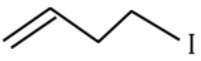 |
| (ii) | 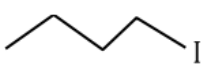 |
| (iii) | 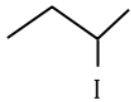 |
| 1. | (i) < (ii) < (iii) | 2. | (ii) < (i) < (iii) |
| 3. | (iii) < (ii) < (i) | 4. | (ii) < (iii) < (i) |
Subtopic: Chemical Properties |
56%
Level 3: 35%-60%
NEET - 2023
Hints
The following compound would be classified as:

| 1. | Vinylic halide | 2. | Benzylic halide |
| 3. | Aryl halide | 4. | Allylic halide |
Subtopic: Introduction and Physical Properties |
69%
Level 2: 60%+
NEET - 2023
Hints


Which of the following methods is incorrect for the synthesis of alkenes?
1. Treatment of alkynes with Na in liquid NH3
2. Heating alkyl halides with alcoholic KOH
3. Treating alkyl halides in aqueous KOH solution
4. Treating vicinal dihalides with Zn metal
1. Treatment of alkynes with Na in liquid NH3
2. Heating alkyl halides with alcoholic KOH
3. Treating alkyl halides in aqueous KOH solution
4. Treating vicinal dihalides with Zn metal
Subtopic: Chemical Properties |
78%
Level 2: 60%+
NEET - 2022
Hints
Select Question Set:

© 2026 GoodEd Technologies Pvt. Ltd.